FTC Disclosure: If you make a purchase via a link on this site, We may receive a small commission on the transaction - at no added cost to you. Thank you!
Hummingbird Moth
The hummingbird moth is an enchanting insect.
Many mistake it for a hummingbird, it is that charming!
On summer evenings, my husband and I sit outside in front of our flower garden watching hummingbirds.
Also, we have the pleasure of viewing these moths, a creature that resembles a hummingbird in many ways.
2 Commong Species of
Hummingbird Moths
There are 2 usual suspects that are categorized as hummingbird moths:
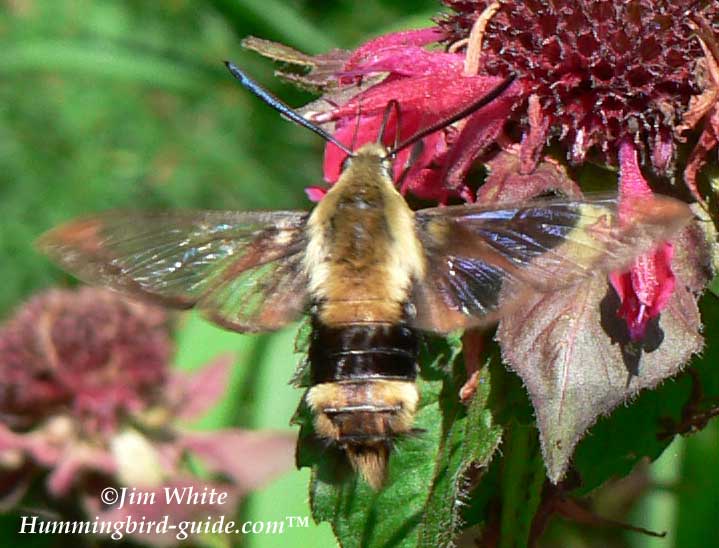
1) The Clearwing Moth (Scientic Name-Hemaris thysbe)
The Clearwing moth is a beautiful insect.
The wings are solid red or brownish with reddish veins.
To add to its lovely appearance, the inner portion of its wings lack scales and are clear giving the moth its name.
The body is olive-green with reddish bands on the lower part.
This moth can be found in the United States and Canada as far north as the Yukon.
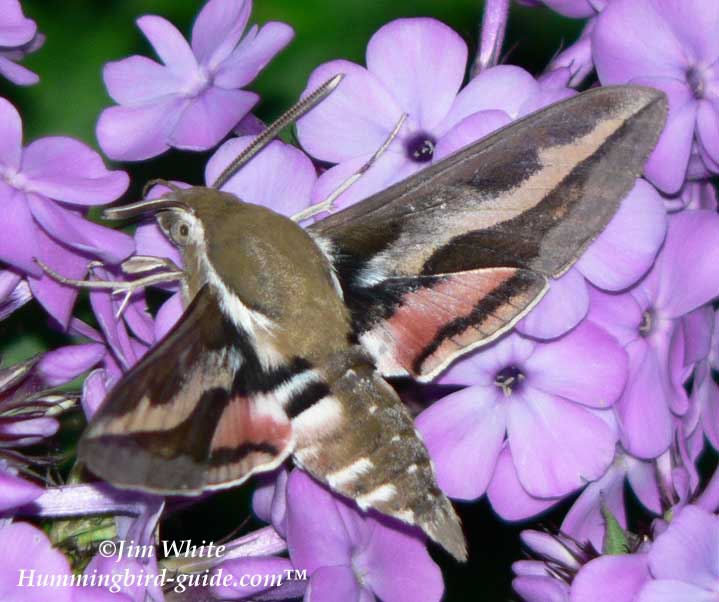
2) White-lined Sphinx (Scientic Name-Hyles lineata)
This moth with its
dark brown wings and white stripes makes a splendid addition to any
garden.
If you aren't sure, just look at those interesting white lines that cover the veins; thus it's name, the White-lined Sphinx Moth.
It can be found throughout Central America into the United States, and parts of Canada.
Characteristics
- I enjoy many of the same flowers
- I am a beneficial pollinator of your garden
- I hover while sipping nectar
- I zip from flower to flower
- I am tiny like a hummingbird
Capturing these fast moving creatures on video is certainly challenging as you can see by my video here:
I am a Hummingbird Moth
A closer inspection reveals the true identity of this mystery creature that fascinates so many. What a revelation to find it has antennae!
What surprised us about this moth is that it is active during the day. We all know how most moths show up at night when we turn on the lights. For us, this fact alone makes this creature enchanting.
How Is A Hummingbird Moth Different Than A Hummingbird!
- Moths have antennae
- Unlike a hummingbird, there are no territory fights.
- You might find it sharing a flower with a hummingbird.
- A Hummingbird Moth keeps it's long tongue curled under it's head and uncurl it to take in the nectar.
- They are quite friendly, humans can come close.
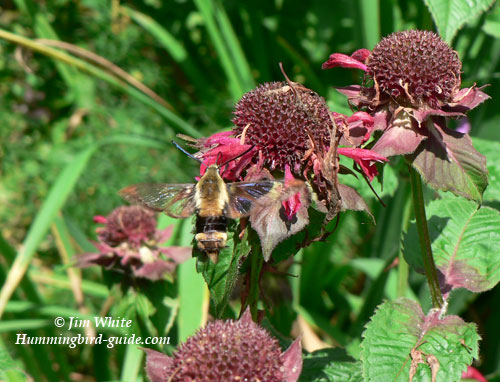
Images of Hummingbird Moths in our Perennial Flower Garden:
Clearwing Hummingbird Moth
White-lined Sphinx Moth
(Sometimes called "Hawk Moth")
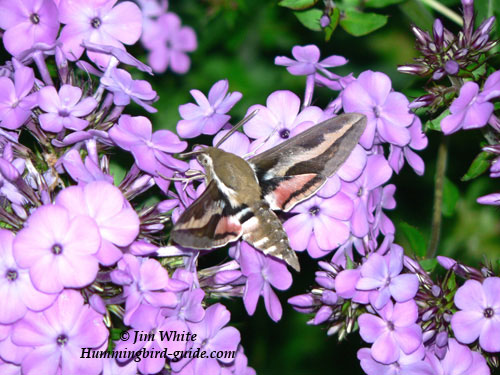
Photography can be a challenge. These moths can fly fast (up to 30 miles per hour), so it can be difficult to capture the perfect picture.
In our hummingbird garden we plant Bee Balm and Phlox. Hummingbird moths enjoy these flowers as well as honeysuckle, verbena, red clover, and wild roses.
Life Cycle of a Hummingbird Moth
Clearwing Moth:
Like many moths, this one lays her eggs on the underside of leaves in early spring.
In case you were wondering, they do hatch into larvae.
Something interesting is that these larvae have a prominent horn on the rear.
You might happen to spot them and identify this insect not as a pest but a wonderful prediction of summer visits from the delightful hummingbird moth.
These larvae only feed on honeysuckle, hawthorn and some other flowers.
The larvae of the Clearwing Moth is dark green with reddish spots on the side with a yellow horn.
When fully grown into a caterpiller, they will borrow into the ground and remain their over winter until they emerge in the Spring.
White-lined Sphinx Moth:
The larvae of the White-lined Sphinx Moth (Hawk Moth) is green with two grey stripes bordered in cream along the sides and the horn at the rear end typical of sphingids.
When fully grown, they climb down the plant and make a cocoon in the dirt where they exist for several weeks before they emerge.
Don't worry because unlike some other members of the sphinx family of moths, this one will stay away from your vegetable garden completely!

James and Ruth White are Certified Hummingbird Habitat stewards with the International Hummingbird Society, specializing in backyard hummingbird care, behavior, and conservation. With 45+ years of hands-on experience, they have cared for over 1,000 hummingbirds, built two large perennial gardens, and support a community of 30,000+ subscribers through hummingbird-guide.com, their widely followed migration map, and active social channels. They observe hummingbirds daily across 12 home feeders and document their behavior through photography and video.
Find Us Here!
 |
 |
 |
 |
 |
 |
 |
 |
 |
Stay in Touch
with the Latest!
Subscribe to the
"Hummer" Newsletter.
Have A Great
Hummingbird Story!
We Would Love
To Hear it!
FTC Disclosure: If you make a purchase via a link on this site, We may receive a small commission on the transaction - at no added cost to you. Thank you!
What's New


-
Stop Feeding Hummingbirds. When to take down your hummingbird feeders.
Aug 28, 26 11:15 AM
 If you stop feeding hummingbirds you will NOT starve them or interupt their migration schedule. There is a widespread myth that taking down feeders too early is detrimental to migration.
 -
Ruby-throated Hummingbird. Number One in the East!
Aug 15, 26 07:53 AM
 The Ruby-throated Hummingbird has a breeding range east of the Mississippi River. Learn about their habitat, behavior, migration and how to identify them.